


You agree before checking what you want. You apologize when someone else is upset. You monitor other people’s moods, avoid disagreement, and work hard to remain useful, pleasant, or easy to be around.
These behaviors can look like ordinary people-pleasing. Sometimes, however, they reflect the fawn response: an automatic attempt to create safety by appeasing the person who feels threatening, unpredictable, or difficult to escape.
Fawning is not weakness or manipulation. It may be a protective strategy that once helped reduce conflict, rejection, punishment, or emotional abandonment.
What Is the Fawn Response?
The fawn response describes a pattern of accommodating, pleasing, or soothing others to prevent danger or preserve connection. It is commonly discussed alongside fight, flight, and freeze.
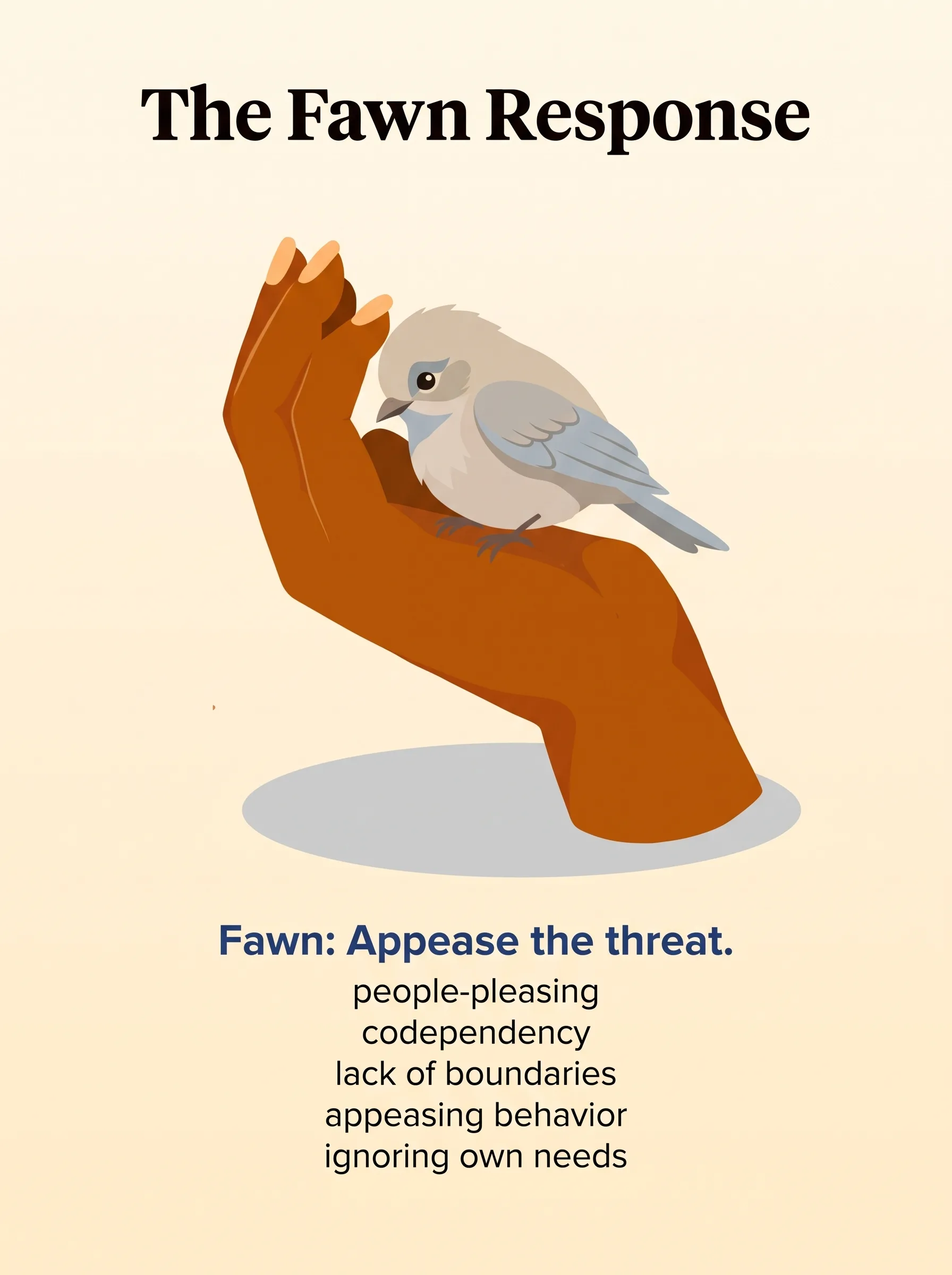
Examples include:
- agreeing to something you do not want;
- immediately apologizing during conflict;
- becoming especially helpful around an angry person;
- hiding your opinions or preferences;
- trying to manage another person’s emotions;
- accepting blame to end tension;
- making yourself smaller, quieter, or easier to control.
The term is widely used in trauma-informed therapy, but it is not a formal diagnosis. Fawning is also better understood as an appeasement behavior than as one clearly defined physiological state.
A person may fawn while internally feeling anxious and highly activated. Someone else may feel numb, disconnected, or unable to think clearly. The outward behavior can look similar even when the internal experience differs.
Healthy Kindness vs. Fawning
Caring about other people is not automatically a trauma response. Cooperation, compromise, and generosity are important parts of healthy relationships.
The key difference is whether you still experience choice.
| Healthy care | Fawn response |
| You help because you want to | You help because saying no feels dangerous |
| You can consider your own needs | Your needs disappear from awareness |
| Disagreement feels uncomfortable but possible | Disagreement feels threatening or unbearable |
| You can tolerate another person’s disappointment | You feel responsible for preventing their disappointment |
| You can change your mind | Changing your mind brings intense guilt or fear |
| Care is generally mutual | You repeatedly overgive to maintain safety or connection |
Fawning often happens quickly. You may say yes, smile, apologize, or offer help before you have time to recognize what you actually feel.
Common Signs of the Fawn Response
The pattern can appear in relationships, families, friendships, therapy, and the workplace.
Possible signs include:
- automatically agreeing with stronger personalities;
- difficulty identifying personal preferences;
- frequently saying that anything is fine;
- apologizing for needs, emotions, or boundaries;
- feeling responsible for everyone’s comfort;
- changing your personality to match the people around you;
- giving excessive explanations when saying no;
- offering help while already exhausted;
- avoiding honest feedback;
- tolerating disrespect to prevent abandonment;
- feeling guilty after setting a reasonable boundary;
- becoming highly attentive to tone, facial expression, or mood;
- struggling to recognize anger until it becomes resentment;
- feeling valuable mainly when you are useful.
One sign alone does not confirm trauma. People-pleasing may also be influenced by family roles, culture, gender expectations, workplace dynamics, attachment patterns, low self-esteem, or social anxiety.
The important questions are whether the behavior feels voluntary, whether it repeatedly harms you, and whether disagreement produces fear that seems larger than the current situation.
Why Fawning Can Become a Survival Strategy
Fawning may develop when direct resistance, escape, or emotional withdrawal does not feel safe or effective.
A child might learn that connection depends on keeping a caregiver calm. An adult in an abusive relationship may appease a partner because confrontation could increase danger. An employee may become excessively agreeable in a workplace where mistakes are punished unpredictably.
The nervous system learns from consequences. If pleasing someone repeatedly reduces conflict, the behavior can become fast and automatic.
Experiences that may contribute include:
- unpredictable or emotionally volatile caregiving;
- punishment for expressing anger or disagreement;
- conditional affection;
- parentification or being responsible for an adult’s emotions;
- bullying or social rejection;
- controlling relationships;
- emotional, physical, or sexual abuse;
- environments where personal boundaries were ignored;
- repeated experiences of being unable to leave.
Research literature more often uses the term appeasement than fawning. A review of traumatic entrapment and appeasement examined how these behaviors may emerge in situations such as domestic abuse, captivity, and other threats that are difficult to escape.
A later paper on appeasement as a survival response argued that accommodating an aggressor may help explain behavior that can otherwise be misunderstood or blamed on the survivor.
This does not mean that every agreeable person has experienced trauma. It means that appeasement can sometimes be adaptive in unsafe conditions.
What Fawning Feels Like in the Body
The fawn response is often discussed as if it were a separate nervous system setting. In practice, appeasement can occur alongside several states.
You may notice:
- tension in the chest, jaw, throat, or stomach;
- smiling or laughing when uncomfortable;
- shallow breathing;
- a rapid heartbeat;
- difficulty finding words;
- mental blankness;
- an urge to agree or apologize;
- reduced awareness of hunger, fatigue, or pain;
- feeling detached from anger;
- relief immediately after the other person calms down.
The relief can reinforce the pattern. Your system learns that self-silencing successfully ended the immediate threat, even when the long-term cost was resentment, exhaustion, or loss of identity.
How Fawning Appears in Adult Relationships
In romantic relationships, fawning may look like accepting plans you dislike, avoiding difficult conversations, overexplaining boundaries, or taking responsibility for a partner’s reactions.
In friendships, you might always provide emotional support but rarely ask for it. You may worry that expressing disappointment will end the relationship.
At work, fawning can appear as:
- accepting unrealistic deadlines;
- doing unpaid or unrecognized labor;
- avoiding questions or constructive disagreement;
- taking responsibility for other people’s mistakes;
- trying to anticipate every request;
- feeling unable to speak honestly with authority figures.
Because the person often appears helpful and cooperative, others may not recognize the anxiety or self-erasure behind the behavior.
The Cost of Chronic People-Pleasing
Fawning may reduce immediate conflict while creating longer-term problems.
Possible consequences include:
- burnout;
- resentment;
- unclear or one-sided relationships;
- difficulty making decisions;
- loss of connection with personal values;
- vulnerability to manipulation;
- suppressed anger;
- anxiety before social interactions;
- exhaustion after being around others;
- uncertainty about who you are outside a relationship.
The pattern can also create confusing relationship dynamics. Other people may believe you genuinely agree because they cannot see the fear or pressure behind your response.
Recovery is not about becoming less caring. It is about making care more honest, mutual, and voluntary.
How to Begin Changing the Fawn Response
A survival pattern usually does not disappear through willpower. Start by creating more time and choice between the request and your response.
1. Notice the Moment Before Yes
Pay attention to early cues:
- holding your breath;
- smiling automatically;
- tension in the throat;
- mental blankness;
- an urge to explain;
- immediate concern about the other person’s reaction.
You do not need to change the response immediately. Recognizing it is the first step.
2. Use a Pause Instead of an Answer
Prepare several phrases that give you time:
- I need to check before I commit.
- Let me think about that.
- I’ll get back to you tomorrow.
- I’m not ready to answer yet.
- I need a moment to consider what works for me.
A pause may feel uncomfortable because the old pattern relies on responding quickly. That discomfort does not necessarily mean the pause is unsafe.
3. Rebuild Awareness of Your Preferences
Practice with low-stakes decisions. Notice which food, music, schedule, temperature, or activity you prefer.
Instead of saying that anything is fine, choose between two options. Small preferences help restore contact with your internal signals.
4. Practice Low-Risk Boundaries
Begin where disagreement is unlikely to create serious consequences.
A boundary might be:
- declining a minor request;
- suggesting a different meeting time;
- correcting an incorrect order;
- asking someone to wait;
- ending a phone call when you are tired.
The goal is not to feel completely confident. It is to experience that a boundary can exist alongside discomfort.
5. Separate Discomfort From Danger
Someone may feel disappointed, confused, or annoyed when you stop automatically accommodating them. Their reaction is information, but it does not always mean you have done something wrong.
Ask:
- Is there an immediate safety risk?
- Am I allowed to take time?
- What boundary would I recommend to someone I care about?
- Am I responsible for this person’s feeling, or only for communicating respectfully?
6. Expect Guilt During Change
Guilt can appear even when a boundary is reasonable. It may reflect an old rule that your safety or worth depends on keeping others satisfied.
You do not have to wait for guilt to disappear before making a different choice. With repetition, the nervous system can learn that disagreement does not always lead to punishment or abandonment.
When Fawning Is Still Protecting You
Boundary advice must account for actual safety. If you are dealing with abuse, coercive control, stalking, financial dependence, or threats, direct confrontation may increase risk.
In that situation, appeasement may still be serving a protective purpose. Focus on a personalized safety plan rather than forcing yourself to become more assertive.
In the United States, confidential support is available through the National Domestic Violence Hotline. If you are in immediate danger, call 911 or the appropriate emergency service in your location.
How Trauma-Informed Therapy Can Help
Therapy can help you understand what the fawn response has been protecting and develop boundaries without shaming the part of you that learned to appease.
Trauma-informed work may involve:
- recognizing the body’s early threat signals;
- separating past danger from present discomfort;
- identifying anger, preferences, and unmet needs;
- practicing boundaries at a manageable pace;
- increasing tolerance for disagreement;
- processing traumatic or controlling experiences;
- building relationships based on mutuality rather than performance.
SAMHSA identifies safety, trust, collaboration, empowerment, voice, and choice as central principles of a trauma-informed approach. These principles are especially important for someone whose earlier relationships required compliance.
Embodied Integrations offers trauma therapy in Denver and online throughout Colorado. Somatic work may also help you recognize when your body moves into automatic agreement, shutdown, or fear before your conscious mind understands what is happening.
From Automatic Appeasement to Genuine Choice
The fawn response may have helped you preserve connection or reduce danger. Healing does not require rejecting that strategy or criticizing yourself for using it.
The goal is to create more options. You can remain considerate without abandoning your needs. You can care about another person’s feelings without becoming responsible for regulating them. You can pause before saying yes.
If people-pleasing, fear of conflict, or difficulty setting boundaries is affecting your relationships, schedule a free 30-minute consultation to explore what kind of support may fit your needs.
This article is educational and does not provide a diagnosis or replace individualized mental health care.

Working with a somatic therapist in Denver
I’m Dennis Guyvan, MA, LPCC — a somatic therapist and founder of Embodied Integrations. If what you just read resonates with you, Trauma therapy in Denver may help you move from understanding your patterns to actually changing them. Sessions are available in person in Denver and online anywhere in Colorado.