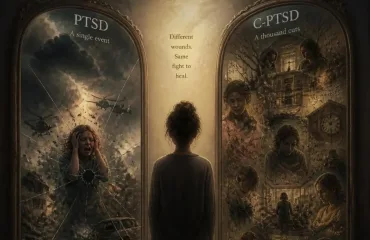


An emotional flashback is a sudden, intense emotional or physical state that appears connected to an earlier traumatic experience. Unlike a typical flashback, it may not include a clear image, sound, or memory of what happened.
Instead, you might suddenly feel terrified, ashamed, powerless, abandoned, or emotionally small—even when the present situation does not fully explain the intensity of the reaction.
The term emotional flashback is commonly used in trauma therapy, especially when discussing complex PTSD. However, it is not a separate diagnosis or a distinct symptom category in the DSM-5-TR or ICD-11.
What Does an Emotional Flashback Feel Like?
Emotional flashbacks can vary widely. A person may experience:
- Sudden fear, shame, anger, or despair
- A strong urge to hide, escape, freeze, or please someone
- Feeling helpless or much younger than their current age
- Intense sensitivity to criticism or rejection
- Emotional numbness or disconnection
- A belief that something terrible is about to happen
- Difficulty speaking, thinking, or making decisions
- A racing heart, tight chest, nausea, shaking, or muscle tension
There may be no obvious memory attached to the experience. This can make the reaction confusing because the person knows intellectually that they are in the present but emotionally feels trapped in an earlier pattern of danger.
Emotional Flashback vs Traditional Flashback
A traditional trauma flashback often includes sensory elements from a past experience. Someone may see images, hear sounds, smell something associated with the trauma, or feel as though the event is happening again.
Research describes PTSD flashbacks as intrusive re-experiencing in which a traumatic event feels present rather than safely located in the past.
An emotional flashback may involve the same sense of past danger returning, but without a vivid scene.
| Traditional flashback | Emotional flashback |
| May include images, sounds, smells, or physical sensations | May involve primarily emotions and body states |
| The connection to a specific event may be clear | The original experience may not be immediately identifiable |
| The person may feel as though the event is happening again | The person may feel as helpless, ashamed, or unsafe as they once did |
| Often recognized as a trauma memory | May initially feel like an unexplained emotional reaction |
These experiences can overlap. Neither type requires a complete or perfectly organized memory.
Why Do Emotional Flashbacks Happen?
Trauma can teach the nervous system to react quickly to signs of possible danger. If an experience in the present resembles an earlier threat, the body may activate a protective response before the person consciously understands what triggered it.
Possible triggers include:
- Someone using a particular tone of voice
- Criticism or perceived disapproval
- Conflict or emotional distance
- Feeling ignored, excluded, or abandoned
- Being asked to set a boundary
- Physical closeness or vulnerability
- Certain places, smells, dates, or sounds
- Feeling trapped or unable to leave
- Authority figures or unequal power dynamics
The present situation does not need to be identical to the original trauma. A small similarity may be enough to activate a learned survival response.
Emotional Flashbacks and C-PTSD
Emotional flashbacks are often discussed in connection with complex PTSD because C-PTSD includes persistent difficulty with emotional regulation, negative self-concept, and relationships.
For example, a minor disagreement may activate intense shame in someone who learned that conflict led to humiliation or abandonment. A delayed reply may bring up a powerful sense of rejection. Constructive feedback may feel like evidence of being fundamentally defective.
These reactions can be related to complex trauma, but emotional intensity alone does not confirm C-PTSD. Similar experiences may occur with PTSD, anxiety, panic, depression, attachment difficulties, dissociation, or other conditions.
How to Recognize an Emotional Flashback
It may be an emotional flashback when:
- The reaction feels much larger than the present event
- Your body responds before you understand why
- You suddenly feel powerless, trapped, or emotionally younger
- Familiar beliefs appear, such as “I am unsafe” or “Everyone will leave”
- You lose access to your usual perspective or coping skills
- The same emotional pattern occurs in similar situations
Recognizing a flashback does not mean dismissing your feelings. The present situation may still require attention or a boundary. The goal is to separate what belongs to the current moment from what may be intensified by the past.
What to Do During an Emotional Flashback
1. Name What May Be Happening
If it feels accurate, quietly remind yourself:
- “This may be an emotional flashback.”
- “My body is responding to something that feels familiar.”
- “This feeling is intense, but it is not the whole present situation.”
Naming the experience can create a small amount of distance from it.
2. Orient Yourself to the Present
Look around and identify where you are. Say the date, your age, and what is happening now.
For example:
“I am 34 years old. I am in my apartment. It is Wednesday evening. That experience is not happening right now.”
Do not force yourself to declare that you are completely safe if that does not feel true. Use accurate language such as, “I have more choices now” or “I can leave this room if I need to.”
3. Use Your Senses
Grounding redirects attention toward information from the present environment. NHS guidance notes that sensory grounding can help people reconnect with the current moment during flashbacks and distressing memories.
Try noticing:
- Five things you can see
- Four things you can physically feel
- Three sounds you can hear
- Two things you can smell
- One thing you can taste
You can also hold a cool object, press your feet into the floor, describe the room aloud, or notice the support of the chair beneath you.
If a grounding exercise increases distress, stop and try something different. No single technique works for everyone.
4. Work With the Body
An emotional flashback may involve a fight, flight, freeze, or fawn response. Gentle physical actions can help the body register that movement and choice are available.
You might:
- Push your hands against a wall
- Walk slowly around the room
- Stretch your arms and shoulders
- Shake out your hands
- Wrap yourself in a blanket
- Place one hand on a stable surface
- Breathe out slightly longer than you breathe in
Avoid forcing deep breaths if they make you dizzy, numb, or more anxious.
5. Reduce Immediate Demands
During an intense flashback, complex decisions and difficult conversations may be harder to manage.
When possible:
- Pause the conversation
- Move to a quieter environment
- Delay non-urgent decisions
- Drink water or eat something
- Contact a trusted person
- Give yourself time before responding to messages
Taking a pause is not avoidance when it helps you regain enough regulation to respond intentionally.
6. Respond Without Shame
Try speaking to yourself as you would to someone experiencing fear after a painful event.
You might say:
- “This reaction developed for a reason.”
- “I do not have to solve everything right now.”
- “I can feel this without punishing myself.”
- “The intensity will change.”
Self-compassion does not mean agreeing with every thought that appears. It means reducing the additional distress created by self-criticism.
What to Do After the Flashback
Once the intensity has decreased, gently review what happened.
It may help to write down:
- What was happening before the reaction began
- What emotions and body sensations appeared
- Which thoughts or beliefs became active
- What helped you reconnect with the present
- What support or boundary may be needed now
The purpose is to notice patterns, not to force yourself to uncover a hidden memory. A strong emotional response does not prove that a specific event occurred.
When Coping Strategies Are Not Enough
Grounding skills may reduce immediate distress, but they do not replace treatment when flashbacks are frequent, severe, or affecting daily life.
Consider professional support if you:
- Regularly lose awareness of the present
- Avoid relationships, work, or necessary activities
- Experience persistent shame or fear
- Use substances or self-harm to manage reactions
- Have difficulty sleeping or functioning
- Feel unable to calm down after triggers
- Experience thoughts of suicide
Trauma therapy can help you understand triggers, develop regulation skills, and process traumatic experiences at a manageable pace. Depending on the person, treatment may include EMDR, Brainspotting, Internal Family Systems, cognitive approaches, or somatic therapy.
Embodied Integrations offers individualized trauma therapy that considers emotional, cognitive, relational, and bodily responses to trauma.
You do not need to identify every memory before seeking help. Therapy can begin with the patterns affecting your life today.
To explore whether trauma-informed support may be a good fit, schedule a free consultation.
If you are in immediate danger or experiencing thoughts of suicide or self-harm, call or text 988 in the United States or contact local emergency services.
This article is for educational purposes and does not provide a diagnosis or replace professional medical or mental health care.

Working with a somatic therapist in Denver
I’m Dennis Guyvan, MA, LPCC — a somatic therapist and founder of Embodied Integrations. If what you just read resonates with you, Trauma therapy in Denver may help you move from understanding your patterns to actually changing them. Sessions are available in person in Denver and online anywhere in Colorado.