

The window of tolerance describes the range of emotional and physiological activation in which you can remain present, think clearly enough, and respond with some degree of choice.
Inside this window, you can experience stress, sadness, anger, excitement, or fear without becoming completely overwhelmed or disconnected. Above the window is hyperarousal, where the system has too much activation. Below it is hypoarousal, where energy, awareness, and connection decrease.
The model can help explain why the same situation feels manageable one day and unbearable the next.
What Is the Window of Tolerance?
Psychiatrist Daniel J. Siegel introduced the window of tolerance within his work on interpersonal neurobiology. The concept was later applied in trauma therapy to describe how autonomic activation can affect emotional processing and the ability to remain engaged.
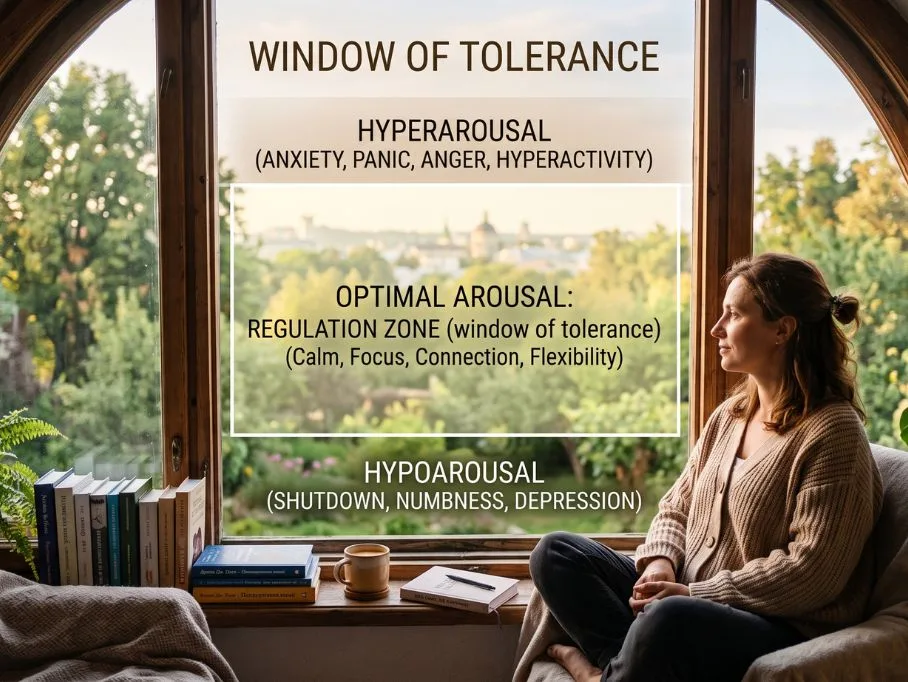
It is best understood as a clinical framework rather than a precise biological measurement. There is no medical test that shows the exact boundaries of your window.
When you are within your window of tolerance, you are generally able to:
- recognize what you feel;
- notice what is happening around you;
- think with reasonable clarity;
- communicate or ask for support;
- make decisions;
- experience emotion without losing all sense of control;
- recover after the stressful event.
Being inside the window does not mean being completely calm. You might feel nervous before a presentation, angry during a difficult conversation, or sad after a loss and still remain present enough to respond intentionally.
The Three Zones of Arousal
The window of tolerance is often represented as three zones.
| Zone | Common experiences | What becomes difficult |
|---|---|---|
| Hyperarousal | Anxiety, panic, tension, agitation, anger, racing thoughts | Slowing down, listening, sleeping, thinking flexibly |
| Window of tolerance | Present, emotionally engaged, alert, connected | Stress is noticeable but remains manageable |
| Hypoarousal | Numbness, exhaustion, heaviness, disconnection, mental fog | Speaking, moving, deciding, connecting, taking action |
These zones are not fixed personality types. You can move between them throughout the day, and different situations may activate different responses.
Hyperarousal: Above the Window of Tolerance
Hyperarousal occurs when activation rises beyond what you can comfortably process. The body prepares for urgent action, even when the situation does not require a full survival response.
Possible signs include:
- rapid or shallow breathing;
- racing heart;
- tight muscles or clenched jaw;
- feeling restless or unable to sit still;
- irritability or sudden anger;
- racing thoughts;
- hypervigilance;
- being easily startled;
- difficulty concentrating;
- sensory overload;
- panic;
- trouble falling or staying asleep.
You may become focused on identifying danger, solving the problem immediately, escaping the situation, or regaining control. Nuance becomes harder to access. A neutral facial expression, delayed message, or minor mistake may feel much more threatening than it would when you are regulated.
The National Institute of Mental Health identifies feeling tense, on guard, easily startled, irritable, and unable to concentrate or sleep as possible arousal and reactivity symptoms of PTSD. However, hyperarousal can also occur with anxiety, acute stress, sleep deprivation, stimulant use, and other conditions.
Hypoarousal: Below the Window of Tolerance
Hypoarousal involves reduced energy, awareness, or emotional connection. It can happen when mobilizing to fight or escape feels unavailable, ineffective, or too exhausting.
Possible signs include:
- emotional numbness;
- heaviness or extreme fatigue;
- slowed thinking;
- difficulty finding words;
- feeling detached from your body;
- reduced awareness of your surroundings;
- withdrawing from people;
- difficulty initiating tasks;
- feeling unreal or far away;
- loss of interest or motivation;
- wanting to sleep or hide.
Hypoarousal can look calm from the outside, but internally it may feel like being frozen, absent, or unable to respond.
This state can overlap with depression, dissociation, burnout, medication effects, sleep problems, and physical illness. Persistent low energy or changes in awareness should not automatically be attributed to the nervous system without appropriate assessment.
Can You Be Hyperaroused and Hypoaroused at the Same Time?
Human responses do not always fit neatly into three separate boxes. You may feel exhausted but unable to sleep, emotionally numb while your heart races, or mentally foggy while your body remains tense.
You can also shift quickly between states. For example, a conflict may first produce anger and rapid speech, followed by silence, numbness, and withdrawal.
The purpose of the window of tolerance model is not to label every moment perfectly. It is to help you notice patterns and choose support that fits your current experience.
What Affects the Size of Your Window?
Your window of tolerance can feel wider or narrower depending on current conditions.
Factors that may reduce your available capacity include:
- lack of sleep;
- hunger, dehydration, or physical illness;
- chronic pain;
- prolonged work or caregiving stress;
- conflict or relational uncertainty;
- sensory overload;
- grief;
- trauma reminders;
- excessive caffeine or stimulant use;
- alcohol or substance use;
- too many demands without recovery time;
- feeling trapped or unable to set a boundary.
Supportive relationships, rest, predictability, physical care, meaningful routines, and effective coping skills may increase the amount of stress you can manage.
This explains why a delayed email may feel minor after a restful weekend but overwhelming during a week of poor sleep, conflict, and back-to-back responsibilities. The event has not necessarily changed; your available capacity has.
How to Recognize Your Window of Tolerance
Rather than asking whether you feel calm, ask whether you still have access to key abilities:
- Can I notice what is happening inside and around me?
- Can I understand what another person is saying?
- Can I pause before reacting?
- Can I identify more than one possible response?
- Can I communicate what I need?
- Can I remain connected to the present?
- Can I recover once the stressor ends?
If most of these capacities remain available, you may still be inside your window even if the experience is uncomfortable.
It can also help to identify your earliest signs of leaving the window. Your first cue might be holding your breath, speaking faster, losing eye contact, becoming unusually agreeable, feeling pressure behind your eyes, or struggling to find words.
Early recognition usually gives you more options than waiting until the response becomes intense.
What Helps When You Are Above the Window?
When you are in hyperarousal, the goal is to reduce unnecessary stimulation and restore orientation without demanding instant calm.
You might try:
- looking around and naming several neutral objects;
- feeling your feet against the floor;
- stepping away from screens or noise;
- walking slowly;
- pressing your palms together or against a wall;
- allowing the exhale to lengthen slightly, if breathwork feels comfortable;
- asking for a pause in the conversation;
- contacting someone whose presence feels steady.
Avoid forcing yourself to sit still if your body needs movement. Also avoid making major decisions while you are unable to process information clearly.
A useful question is: What would make this moment five percent more manageable?
What Helps When You Are Below the Window?
Hypoarousal often requires gentle activation rather than more calming.
Possible options include:
- opening curtains or moving toward natural light;
- standing up and feeling your legs support you;
- taking several purposeful steps;
- listening to familiar music with a steady rhythm;
- washing your hands with comfortably warm or cool water;
- naming what you can see out loud;
- eating or drinking something;
- completing one small physical task;
- speaking with a trusted person.
Begin gradually. Too much stimulation can move the system from shutdown directly into overwhelm.
For more ideas, see these somatic exercises for moving from shutdown toward optimal arousal.
The Role of Co-Regulation
Regulation is not always an individual task. People often regain stability through contact with someone who feels predictable, respectful, and emotionally present.
Co-regulation may involve:
- hearing a familiar voice;
- receiving clear information;
- sitting near someone trustworthy;
- being listened to without interruption;
- knowing that your boundaries will be respected;
- borrowing another person’s slower pace.
A supportive relationship does not remove the emotion. It creates conditions in which the emotion may become easier to experience without losing connection.
This is one reason the quality of the therapeutic relationship matters as much as the specific regulation technique.
Can You Expand Your Window of Tolerance?
The goal is not to eliminate hyperarousal and hypoarousal. Both are part of the body’s protective capacity.
Over time, therapy and repeated regulation practice may help you:
- identify activation earlier;
- remain present with a wider range of sensations and emotions;
- move through stress without escalating as quickly;
- return more efficiently after becoming overwhelmed;
- communicate boundaries before reaching shutdown;
- experience discomfort without automatically interpreting it as danger.
This is often described as widening the window of tolerance. A more precise way to think about it is increasing flexibility and capacity.
Growth should happen gradually. Deliberately overwhelming yourself does not necessarily build tolerance and may reinforce the sense that strong emotions are unsafe.
How Somatic Therapy Works With the Window
Somatic therapy pays attention to sensations, posture, movement, impulses, breathing, and changes in activation alongside thoughts and emotions.
A therapist may help you:
- map your personal signs of hyperarousal and hypoarousal;
- identify triggers and available safety cues;
- approach difficult sensations in manageable amounts;
- move attention between discomfort and steadiness;
- practice protective movements or boundaries;
- reconnect with the present after dissociation;
- integrate physical responses with language and meaning.
This differs from simply teaching relaxation exercises. The work is personalized to your patterns and should remain collaborative and consent-based.
For a broader comparison, read Somatic Therapy vs. Talk Therapy.
What the Window of Tolerance Does Not Mean
The model is useful, but several misunderstandings can make it less helpful.
Being Outside the Window Is Not Failure
Moving into hyperarousal or hypoarousal does not mean that you handled the situation badly. Your system may be responding to cumulative stress, past learning, current danger, or limited available capacity.
Regulation Is Not Emotional Suppression
The goal is not to push anger, grief, or fear away. Regulation makes it more possible to experience emotion without being controlled or disconnected by it.
There Is No Universal Regulation Tool
Deep breathing, meditation, movement, conversation, or sensory input may help one person and overwhelm another. The right strategy depends on the person, state, setting, and moment.
The Window Is Not a Diagnosis
The model cannot determine whether you have PTSD, an anxiety disorder, depression, dissociation, or a medical condition. It is a way to organize experience, not replace professional assessment.
A 2010 clinical paper applied the window of tolerance model to complex emotional trauma, while an NHS resource uses it as a visual framework for understanding hyperarousal, hypoarousal, and manageable emotional activation.
When to Seek Support
Professional support may be appropriate when you frequently leave your window of tolerance or have difficulty returning without avoidance, substances, or complete withdrawal.
Consider speaking with a therapist or healthcare provider if you experience:
- recurring panic;
- persistent numbness or disconnection;
- frequent dissociation;
- trauma-related symptoms;
- sleep problems that impair daily life;
- intense emotional reactions that affect relationships;
- difficulty working or completing routine tasks;
- physical symptoms that have not been evaluated.
Seek urgent medical care for chest pain, fainting, severe breathing difficulty, sudden confusion, weakness, or other potentially serious symptoms.
Finding More Flexibility With Somatic Therapy
Embodied Integrations offers somatic therapy in Denver and online throughout Colorado. Dennis Guyvan, MA, LPCC, integrates somatic work with approaches such as EMDR, Brainspotting, and IFS according to each client’s goals and capacity.
The aim is not to stay inside the window every moment. It is to recognize your state sooner, respond with greater choice, and find your way back without shame.
If hyperarousal, shutdown, or rapid shifts between the two are affecting your life, schedule a free 30-minute consultation to explore what kind of support may fit your needs.
This article is educational and does not provide a diagnosis or replace individualized medical or mental health care.

Working with a somatic therapist in Denver
I’m Dennis Guyvan, MA, LPCC — a somatic therapist and founder of Embodied Integrations. If what you just read resonates with you, Somatic therapy in Denver may help you move from understanding your patterns to actually changing them. Sessions are available in person in Denver and online anywhere in Colorado.