

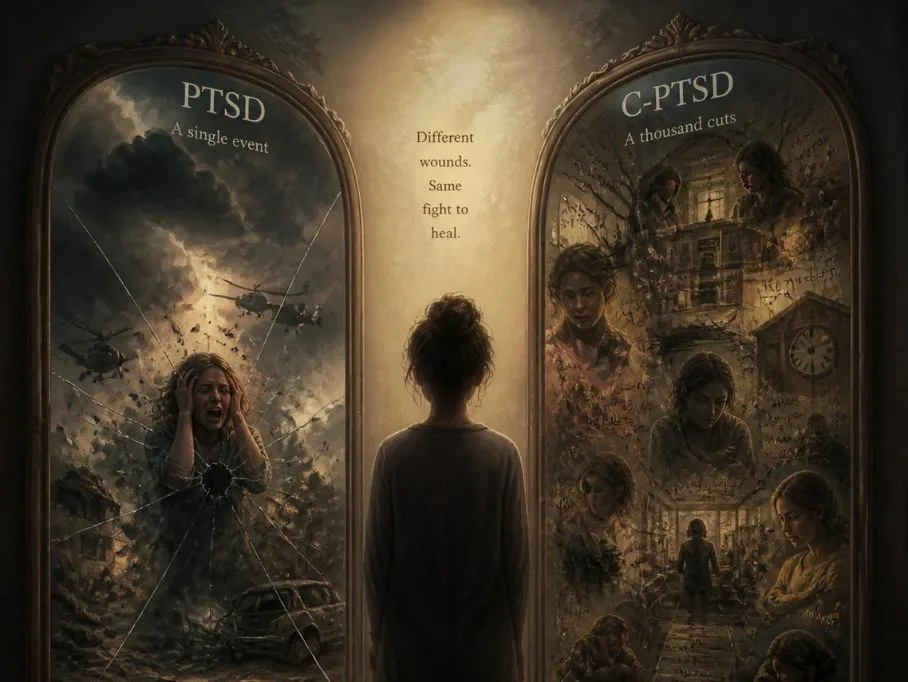
PTSD and complex PTSD are both responses to trauma. They share symptoms such as flashbacks, avoidance, and feeling persistently unsafe. The main difference is that complex PTSD also involves lasting difficulties with emotional regulation, self-worth, and relationships.
C-PTSD is often associated with prolonged or repeated trauma, especially when escape or support was limited. However, the type of trauma alone does not determine the diagnosis.
PTSD vs C-PTSD at a Glance
| Area | PTSD | Complex PTSD |
| Core trauma symptoms | Re-experiencing, avoidance, and a persistent sense of threat | The same core PTSD symptoms |
| Emotional regulation | May be affected | Severe or persistent difficulty managing emotions |
| Self-concept | Guilt or negative beliefs may occur | Deep, ongoing shame, worthlessness, or a damaged sense of self |
| Relationships | Detachment or mistrust may occur | Persistent difficulty with trust, closeness, boundaries, or connection |
| Common trauma pattern | Can follow a single event or repeated trauma | More often associated with prolonged, repeated, or difficult-to-escape trauma |
| ICD-11 diagnosis | Recognized as a separate disorder | Recognized as a separate disorder |
| DSM-5-TR diagnosis | Recognized | Not listed as a separate diagnosis |
The distinction is not that C-PTSD is simply a more severe version of PTSD. Under ICD-11, the conditions have related but different symptom profiles.
Symptoms Shared by PTSD and C-PTSD
According to the ICD-11 framework, both PTSD and C-PTSD involve three core symptom groups.
Re-Experiencing the Trauma
A person may feel as though the trauma is happening again rather than simply remembering it.
Symptoms can include:
- Vivid flashbacks
- Trauma-related nightmares
- Intense distress after reminders
- Strong physical reactions, such as shaking or a racing heart
- Sudden emotional states connected to the trauma
Avoidance
Avoidance is an attempt to reduce distress by staying away from trauma-related experiences.
This may involve avoiding:
- Certain people or places
- Conversations about what happened
- Thoughts, emotions, or bodily sensations
- Situations that involve vulnerability
- Activities that resemble the traumatic experience
Although avoidance can feel protective in the short term, it may gradually restrict relationships, work, and everyday activities.
A Persistent Sense of Threat
The nervous system may remain prepared for danger even when the current environment is relatively safe.
Possible signs include:
- Hypervigilance
- Being easily startled
- Irritability
- Difficulty sleeping
- Problems concentrating
- Constantly scanning for danger
- Feeling unable to relax
These shared symptoms are central to both PTSD and C-PTSD.
What Makes C-PTSD Different?
In addition to PTSD symptoms, C-PTSD includes three areas collectively described as disturbances in self-organization.
The National Center for PTSD identifies these areas as difficulty managing emotions, a negative sense of self, and persistent relationship problems.
Difficulty Regulating Emotions
A person with C-PTSD may have trouble recognizing, tolerating, or recovering from strong emotions.
This can look like:
- Intense anger or sadness
- Emotional reactions that feel disproportionate to the present situation
- Difficulty calming down after conflict
- Emotional numbness or shutdown
- Dissociation
- Using substances, food, work, or other behaviors to escape distress
These reactions may have developed as survival strategies in an environment where emotions could not be safely expressed or supported.
Persistent Negative Self-Concept
PTSD can involve guilt and negative beliefs, but C-PTSD often affects a person’s broader sense of identity.
Someone may consistently feel:
- Defective or damaged
- Unworthy of care
- Responsible for what happened
- Deeply ashamed
- Different from everyone else
- Unable to imagine a positive future
These beliefs can remain even when the person intellectually understands that the trauma was not their fault.
Difficulty With Relationships
Complex trauma can affect the ability to feel safe with other people.
Relationship patterns may include:
- Difficulty trusting others
- Fear of abandonment or rejection
- Avoiding emotional intimacy
- Staying in harmful relationships
- Struggling to set boundaries
- People-pleasing to prevent conflict
- Alternating between seeking closeness and withdrawing
These patterns are not personality flaws. They may be learned protective responses that once helped the person maintain safety or connection.
Does C-PTSD Always Come From Childhood Trauma?
No. C-PTSD is often linked to repeated childhood abuse or neglect, but childhood trauma is not required for the diagnosis.
Other associated experiences may include:
- Domestic violence
- Coercive or controlling relationships
- Sexual exploitation or trafficking
- Captivity or torture
- War and displacement
- Institutional abuse
- Repeated community violence
- Prolonged workplace or identity-based abuse
The ICD-11 does not require one specific type of trauma. Research suggests C-PTSD is more likely after chronic interpersonal trauma, but PTSD or C-PTSD can develop after different traumatic experiences.
Trauma history alone cannot establish the diagnosis. Clinicians also consider current symptoms, their duration, and how they affect daily functioning.
Why Are the Diagnoses Different in the ICD-11 and DSM-5-TR?
The two major diagnostic systems organize trauma responses differently.
The World Health Organization’s ICD-11 recognizes PTSD and C-PTSD as separate diagnoses. A person is diagnosed with one or the other—not both.
The DSM-5-TR, commonly used in the United States, does not include C-PTSD as a separate diagnosis. Its broader PTSD criteria already include symptoms such as negative beliefs, self-blame, detachment, anger, and self-destructive behavior.
Because of this, someone experiencing complex trauma symptoms in the United States may receive a PTSD diagnosis along with additional diagnoses or a clinical description of complex features. This does not make their experiences less valid; it reflects differences between diagnostic systems.
Can You Have Complex Trauma Without C-PTSD?
Yes. Complex trauma describes exposure to prolonged or repeated traumatic experiences. C-PTSD is a specific diagnostic pattern.
Someone with a complex trauma history might develop:
- PTSD
- C-PTSD
- Depression or anxiety
- Dissociative symptoms
- Substance-use problems
- Relationship difficulties
- Few or no lasting mental health symptoms
Not everyone who experiences trauma develops a trauma-related disorder. Protective relationships, access to support, biology, age, and current circumstances can all influence the response.
How Are PTSD and C-PTSD Diagnosed?
Diagnosis involves more than checking symptoms online. A trauma-informed clinician may explore:
- The symptoms you currently experience
- When they began and how persistent they are
- How they affect work, relationships, sleep, and daily activities
- Trauma history without requiring unnecessary detail
- Emotional regulation, identity, and relationship patterns
- Other mental or physical health conditions
- Medication and substance use
The International Trauma Questionnaire can support an ICD-11 assessment, but it should not be treated as a stand-alone diagnosis.
C-PTSD can overlap with depression, anxiety disorders, dissociative disorders, borderline personality disorder, ADHD, and other conditions. A careful assessment helps identify which explanation best fits the overall pattern.
Is Treatment Different?
PTSD and C-PTSD can both respond to trauma-focused therapy. Treatment should be adapted to the person rather than based only on the diagnostic label.
For PTSD, therapy may focus more directly on processing traumatic memories, reducing avoidance, and updating beliefs connected to the event.
C-PTSD treatment may also place greater emphasis on:
- Establishing present-day safety
- Developing emotional regulation skills
- Recognizing nervous-system responses
- Reducing shame and self-blame
- Strengthening boundaries
- Building safer relationships
- Developing a more stable sense of identity
Some people benefit from a stabilization period before directly processing traumatic memories. Others are ready for trauma-focused work sooner. There is no universal sequence that works for everyone.
At Embodied Integrations, trauma therapy may draw from EMDR, Brainspotting, Internal Family Systems, and somatic therapy according to the client’s symptoms, needs, and readiness.
The Diagnosis Is a Guide, Not an Identity
The difference between PTSD and C-PTSD can help explain why trauma affects more than memories. For some people, it also shapes emotional regulation, identity, connection, and the body’s expectations of safety.
A diagnosis can guide treatment, but it does not define who you are. The important question is not only which label applies, but what support will help you feel safer, more connected, and more able to make choices in the present.
If trauma symptoms are affecting your daily life, you can schedule a free consultation to explore whether trauma-informed therapy may be a good fit.
If you are in immediate danger or experiencing thoughts of suicide or self-harm, call or text 988 in the United States or contact local emergency services.
This article is for educational purposes and does not provide a diagnosis or replace professional medical or mental health care.

Working with a somatic therapist in Denver
I’m Dennis Guyvan, MA, LPCC — a somatic therapist and founder of Embodied Integrations. If what you just read resonates with you, Trauma therapy in Denver may help you move from understanding your patterns to actually changing them. Sessions are available in person in Denver and online anywhere in Colorado.